Quick Answer
Average U.S. electricity bill: $2,004/year (EIA 2024). Cut 20-30% with ENERGY STAR appliances, Nest/Ecobee smart thermostats ($50-75 rebates from AEP Ohio, PECO, Eversource), and LED upgrades (90% less energy than incandescent). Ohio Home Weatherization Assistance Program offers free upgrades. Stack efficiency savings with competitive rates on ElectricRates.org.
Why Energy Efficiency Matters in 2026
Note: the average American household is spending $167 a month on electricity right now. That adds up to $2,004 every year, according to the latest Energy Information Administration numbers.
But here's what really gets me. Most homes are wasting 20-30% of that energy. We're talking about $400-600 annually just disappearing because of old equipment, poor insulation, and habits we don't even think about.
Why does this matter in 2025? Electricity rates keep climbing across deregulated markets. The good news is that efficiency improvements offer some of the best returns you'll find anywhere. We're not talking years to break even. We're talking months.
The smartest play? Combine efficiency upgrades with competitive electricity rates. Do both and you can cut your total bill by up to 44%. These strategies work whether you're in Ohio, Pennsylvania, or Massachusetts, no matter your climate or home type.
Tips 1-5 - No-Cost Quick Wins That Start Saving Today
You don't need to spend a dollar to start cutting your electric bill today.
Tip #1: Kill phantom loads (saves $165-308/year)
Phantom loads are sneaky. They waste 5-10% of your home's energy just sitting there. Unplug phone chargers when you're not using them since they're drawing power even without a device attached. For entertainment centers and office equipment, plug everything into power strips and flip them off at night. Simple as that.
Tip #2: Adjust your thermostat schedule (saves 10%/year on HVAC)
Adjust your thermostat 7-10°F for eight hours daily when you're sleeping or away from home. In summer, set it to 78°F when you're home and higher when you're out. In winter, keep it at 68°F during the day and lower at night. You won't notice the difference but your wallet will.
Tip #3: Run full loads only
This one's straightforward. Only run your dishwasher and washing machine with full loads. Running partial loads wastes water, energy, and detergent. Wait until you've got a full load.
Tip #4: Wash clothes in cold water
Here's something most people don't realize: heating water accounts for 90% of your washing machine's energy use. Modern detergents work just fine in cold water, so make the switch.
Tip #5: Use natural light and ventilation
Open your curtains during the day to cut down on lighting needs. Use ceiling fans instead of AC when possible. Fans use 90% less energy and they'll keep you comfortable on milder days.
Tips 6-7 - LED Lighting and The Fastest ROI Home Upgrade
LED bulbs use 75% less energy than traditional incandescents and last 25 times longer. If you haven't switched yet, this is the easiest win.
Tip #6: Replace incandescent bulbs with LEDs. Here's the math. A 60-watt incandescent running 4 hours a day costs about $7/year. The 10-watt LED equivalent? $1.40/year. That's $5.60 saved per bulb, and LEDs cost $2-5 each. You're looking at a 6-18 month payback.
The average home has 30-40 bulbs. After the initial investment, you're saving $150-200 annually. It adds up.
Tip #7: Install dimmer switches and motion sensors. Dimming LEDs by just 25% saves 20% on energy. Motion sensors eliminate the "lights left on" problem entirely. For outdoor lights, motion sensors improve security while cutting costs.
Start with your most-used lights (kitchen, living room, bathrooms) for the fastest ROI.
Tips 8-9 - Smart Thermostats and Set It and Forget It Savings
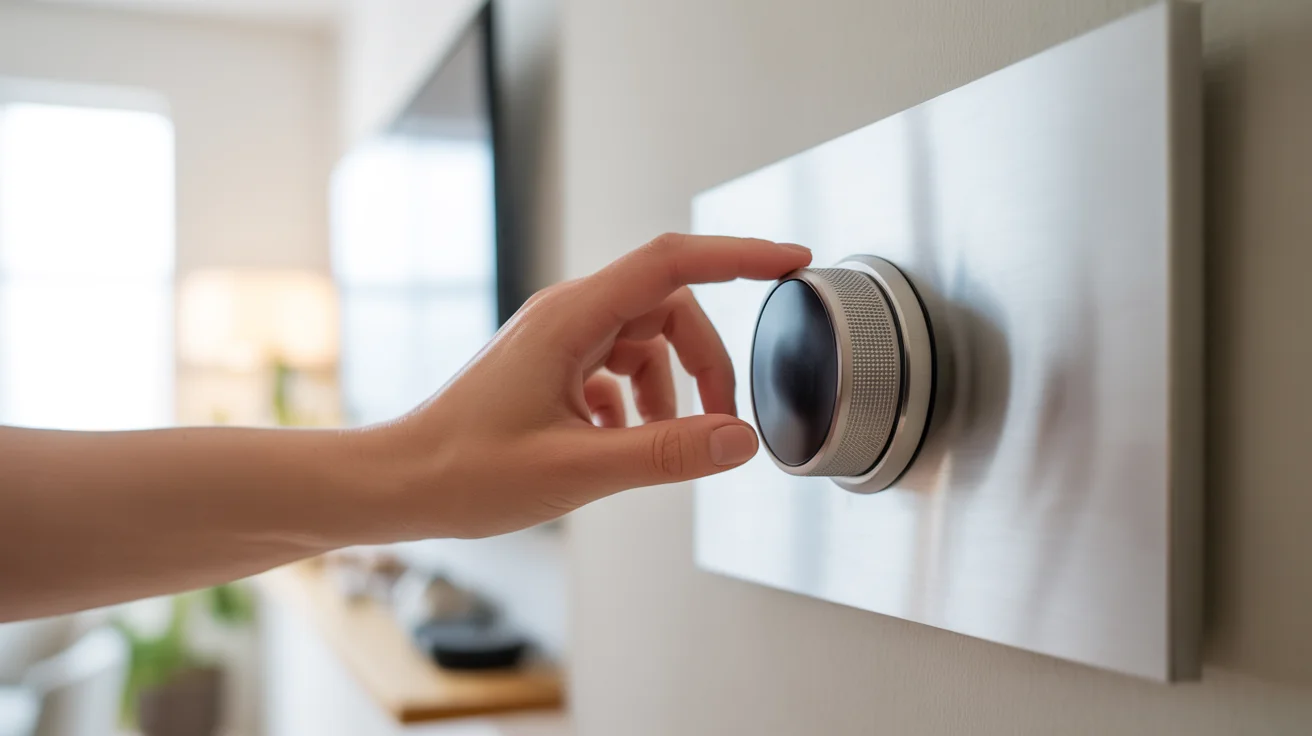
Smart thermostats like Nest and ecobee save 8-26% on heating and cooling costs, according to EPA and manufacturer studies.
Tip #8: Install a smart thermostat. The average household spends $800-1,000/year on HVAC. A smart thermostat cuts $64-260 off that, paying for itself in 6-36 months. Installation takes about 30 minutes and most systems don't need an electrician. Check for utility rebates too. Many offer $50-100 back.
Tip #9: Enable geofencing and scheduling features. This is where the real savings happen. Learning algorithms adapt to your schedule automatically. Geofencing adjusts the temperature when you leave or return home. Remote control means you'll never heat or cool an empty house again. Set vacation mode when you travel.
Hidden benefits: smart thermostats show exactly when and how you're using energy, remind you to change filters, and alert you to HVAC problems before they become expensive repairs.
Tips 10-13 - HVAC Optimization and Managing Your Biggest Energy User
Your heating and cooling system consumes 40-50% of your home's total energy. That makes HVAC optimization the single biggest opportunity for meaningful savings.
Tip #10: Replace air filters regularly. Dirty filters increase energy use by 5-15%. Check monthly, replace every 1-3 months. Filters cost $5-20 each. This is the lowest-effort, highest-impact maintenance you can do.
Tip #11: Schedule annual HVAC maintenance. A tuned-up system runs 15-20% more efficiently. Professional maintenance costs $75-150 per visit but saves $150-300 annually. It also catches problems before they become expensive repairs.
Tip #12: Seal your ductwork. Leaky ducts waste 20-30% of conditioned air. All that cooled or heated air just disappears into your attic or crawlspace. Professional duct sealing runs $300-500 but saves $200-400 annually.
Tip #13: Maintain your outdoor AC unit. Keep it clear of debris and vegetation. Maintain at least two feet of clearance around the unit for proper airflow. Clean the condenser coils annually. A blocked unit works harder and dies sooner.
Tips 14-16 - Weatherization and Insulation as Invisible Money Savers
Proper insulation and air sealing can reduce your annual heating and cooling costs by up to 11%, saving $220-400 for the average household.
Tip #14: Get a home energy audit. This identifies your biggest energy loss opportunities. Many utilities offer free or subsidized audits. Professionals use thermal imaging to show exactly where your home bleeds energy. It's eye-opening.
Tip #15: Add attic insulation. Most homes need R-38 to R-60 depending on climate. Here's a quick test: if you can see ceiling joists, you need more insulation. It's a DIY-friendly project at $1-3 per square foot, and it's the highest ROI weatherization project you can do.
Tip #16: Seal air leaks around windows and doors. Important: seal first, then insulate. Order matters. Focus on gaps around windows, doors, outlets, and plumbing penetrations. Total cost is under $50 for caulk and weatherstripping, but it eliminates drafts that cost hundreds annually.
Tips 17-19 - Energy-Efficient Appliances and When to Replace Them
Energy Star certified appliances use 10-50% less energy than standard models. But don't replace working appliances just for efficiency. When something breaks, that's when you choose wisely.
Tip #17: Upgrade old refrigerators (pre-2010). Modern models use 40% less energy than 15-year-old units. If your fridge is from before 2010, replacing it could save $100-150 annually. And top-freezer models are 10-25% more efficient than side-by-side designs.
Tip #18: Choose Energy Star washing machines. Front-loaders use 45% less water and 25% less energy than top-loaders. The better spin extraction also reduces dryer time. Check for utility rebates. $50-200 is often available.
Tip #19: Use your dishwasher instead of hand washing. Counterintuitive, but Energy Star dishwashers use less water than hand washing. Skip the heated dry cycle and let dishes air dry. Run only full loads for maximum efficiency.
Tips 20-22 - Water Heating Efficiency and The Overlooked Opportunity
Water heating accounts for 18% of your home's energy use. It's the second-largest expense after HVAC, yet most people never think about it.
Tip #20: Lower your water heater temperature to 120°F. Most heaters come set to 140°F, which is hotter than you need. 120°F is perfectly adequate for households and saves 3-5% on heating costs ($30-60/year). It also reduces scalding risk.
Tip #21: Insulate your water heater tank and pipes. A tank blanket costs $20-30. Pipe insulation for the first 6 feet runs $10-15. Combined savings: $20-45 annually with payback under a year. One of the best returns you'll find.
Tip #22: Take shorter showers. Each minute less saves 2.5 gallons of hot water. A family of 4 cutting just 2 minutes each saves $100+ per year. Low-flow showerheads maintain pressure while using less water, so you don't have to sacrifice comfort.
Tips 23-25 - Additional Quick Wins
These often-overlooked strategies round out your energy-saving toolkit.
Tip #23: Unplug your second refrigerator. That garage or basement fridge costs $50-150/year to run. If you're only using it occasionally, unplug it when not needed. Old models are especially inefficient and often not worth keeping plugged in.
Tip #24: Use smart power strips. They automatically cut power when devices enter standby mode. Cost: $25-40 each. Eliminates phantom loads without you having to remember to unplug things. Perfect for entertainment centers and home offices.
Tip #25: Switch to a competitive electricity supplier. This reduces your price per kWh independent of how much you use. Savings run 15-25% on supply charges. No installation, no service interruption, no hassle. Compare rates at ElectricRates.org.
How ElectricRates.org Maximizes Your Total Savings
Energy efficiency reduces how much electricity you use, but it doesn't touch how much you pay per kilowatt-hour. That's where competitive electricity rates come in.
Think of it as a two-pronged strategy. Efficiency reduces your usage (kWh). Competitive rates reduce your price (¢/kWh). Combined, you can cut your total bill by up to 44%.
Here's a real example. Starting bill: $167/month. After efficiency improvements: $117-134/month. After switching to a competitive supplier: $84-116/month. Total savings: $50-83/month, or $600-996/year.
How ElectricRates.org works: enter your ZIP code, see real offers from licensed suppliers, and switch online in minutes. No installation, no service interruption, no fees. Your utility still delivers power and fixes outages. You just pay less.
Your Home Energy Action Plan - Next Steps for Maximum ROI
Don't try to do everything at once. Prioritize by return on investment and start with changes that deliver immediate results.
Week 1: No-cost strategies. Adjust thermostats, unplug phantom loads, optimize appliance use. Cost: $0. Savings: $200-400/year. This is pure profit.
Month 1: Quick upgrades. Replace high-use bulbs with LEDs. Install a smart thermostat. Cost: $150-300. Savings: $150-350/year. Payback: 6-18 months.
Months 2-3: Weatherization. Air seal gaps and add insulation. Get a professional energy audit. Cost: $300-1,200. Savings: $220-500/year.
Months 4-6: HVAC maintenance. Schedule a professional tune-up. Seal ductwork if needed. Cost: $75-650. Savings: $200-400/year.
Ongoing: Replace failing appliances with Energy Star models when they die. Check ElectricRates.org quarterly for competitive supplier offers.
Even small steps matter. Starting with $0-cost changes can fund larger projects through the savings you generate.
Frequently Asked Questions
What's the fastest way to reduce my electricity bill?
How much can smart thermostats save?
Are Energy Star appliances worth the extra cost?
What's the ROI on LED bulbs?
Should I get a home energy audit?
How does energy efficiency combine with competitive rates?
Looking for more? Explore all our Energy Efficiency guides for more helpful resources.
About the author

Consumer Advocate
Brad has analyzed thousands of electricity plans since 2009. He understands how electricity pricing works, why some "low" rates end up costing more, and what to look for in an Electricity Facts Label. He writes to help people make sense of a confusing market.
Compare rates in your area
Topics covered
Sources & References
- EIA - Residential Energy Consumption Survey (U.S. Energy Information Administration): "Average US household spends approximately $2,004 annually on electricity"Accessed Jan 2025
- ENERGY STAR - Savings Calculator (U.S. Environmental Protection Agency): "ENERGY STAR certified products can save households up to 30% on energy bills"Accessed Jan 2025
- DOE - Weatherization Assistance Program (U.S. Department of Energy): "DOE Weatherization Assistance Program helps low-income families reduce energy costs"Accessed Jan 2025
Last updated: June 15, 2025